
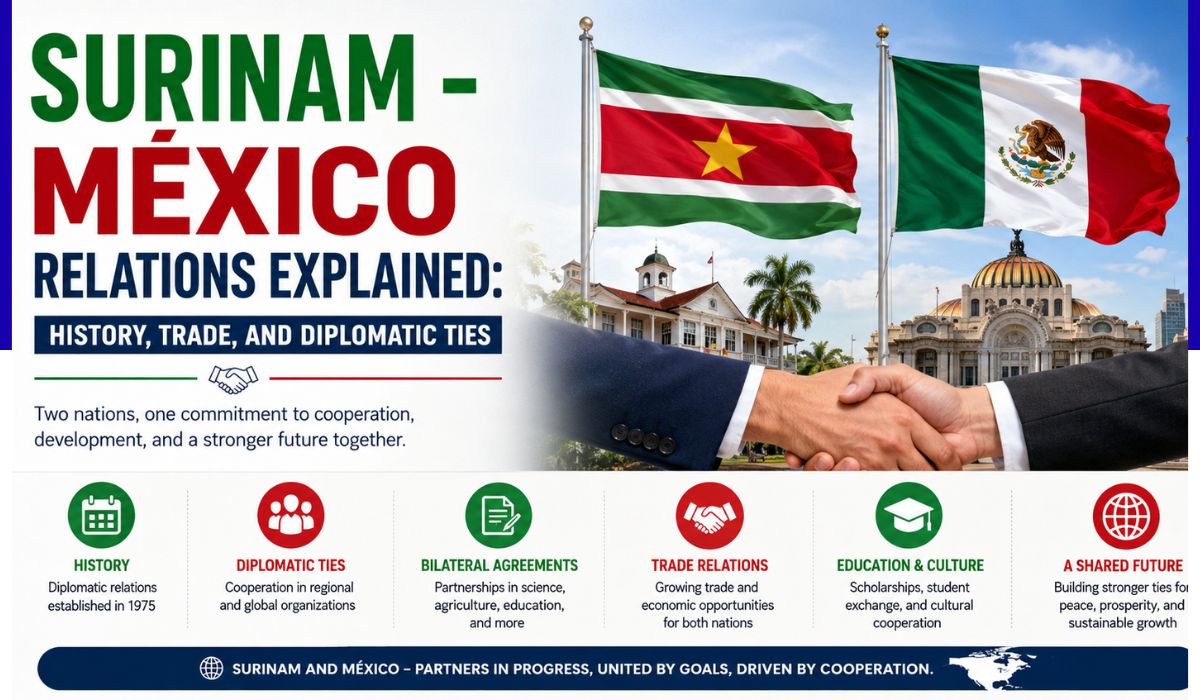
The relationship between Surinam and México is one of the quieter but still meaningful partnerships in the wider Latin American and Caribbean region. Even though both countries are very different in size, language, and colonial history, their diplomatic path has been steady since the mid-1970s. The focus keyword “surinam – méxico” reflects this growing interest in how two geographically distant nations continue to build cooperation in diplomacy, trade, education, and international forums. Understanding Surinam–México relations helps us see how small and large economies in the Americas connect through shared goals in development, stability, and regional unity.
Quick Bio Information
Surinam Independence Year 1975
México Independence Year 1821
Diplomatic Relations Start Date 25 November 1975
Shared Organization United Nations
Shared Organization Organization of American States
Shared Organization Community of Latin American and Caribbean States
Shared Organization Association of Caribbean States
Surinam Former Embassy Location Mexico City
Surinam Current Diplomatic Representation Washington D.C.
México Diplomatic Coverage Port of Spain Trinidad and Tobago
México Honorary Consulate Location Paramaribo
2023 Trade Volume 25.8 Million USD
México Main Exports Steel Vehicles Pipes Oil Products
Surinam Main Exports Machinery Clothing Tools Containers
Notable Company Presence Cemex In Surinam
Key Agreement Year 2012 Scientific Technical Cooperation
Consultation Agreement Year 2021 Memorandum Of Understanding
Education Cooperation Scholarships For Surinamese Students
Key Political Visit 2021 CELAC Summit In México City
Historical Background Of Surinam And México
Surinam and México have very different historical roots, which makes their modern relationship even more interesting. México was colonized by Spain and achieved independence in 1821, becoming one of the earliest independent nations in Latin America. Surinam, on the other hand, was colonized mainly by the Netherlands and gained independence much later in 1975, making it one of the youngest countries in the Western Hemisphere. These different colonial experiences shaped their languages, institutions, and foreign policies. Despite these differences, both countries gradually found common ground through regional cooperation and shared participation in American diplomatic platforms.
Establishment Of Diplomatic Relations In 1975
The official beginning of Surinam–México relations came on 25 November 1975, immediately after Surinam became independent. México quickly recognized the new nation and established diplomatic ties as part of its broader commitment to Latin American and Caribbean solidarity. From the beginning, the relationship was built on mutual respect and cooperation rather than economic dependence or political alignment. This early recognition helped Surinam integrate into regional diplomacy while giving México a stronger presence in the Caribbean diplomatic landscape.
Shared Membership In Global And Regional Organizations
One of the strongest foundations of Surinam–México relations is their shared participation in international organizations. Both countries are active members of the United Nations, where they cooperate on global issues such as climate change, development, and peacebuilding. They also work together within the Organization of American States, the Association of Caribbean States, and the Community of Latin American and Caribbean States. These platforms allow Surinam and México to engage regularly on political, economic, and social challenges affecting the region, strengthening their diplomatic bond over time.
Diplomatic Missions And Representation Structure
Unlike some close allies, Surinam and México do not maintain full embassies in each other’s capitals. Surinam once opened an embassy in Mexico City in 1982, showing early enthusiasm for closer ties, but it was closed in 1986 due to financial limitations. Today, Surinam is represented in México through its embassy in Washington, D.C., which handles diplomatic matters. México, meanwhile, covers Surinam through its embassy in Port of Spain, Trinidad and Tobago, and also maintains an honorary consulate in Paramaribo. This arrangement shows that while the relationship is friendly, it operates at a modest diplomatic level.
High-Level Visits And Political Engagement
Over the years, several high-level visits have helped maintain momentum in Surinam–México relations. Surinamese leaders have attended important summits hosted in México, including the Monterrey Special Summit of the Americas in 2002 and the World Economic Forum on Latin America in 2012. President Chan Santokhi also visited México in 2021 for a Community of Latin American and Caribbean States meeting. These visits are important because they allow direct dialogue between leaders and help both nations align on regional priorities such as development, trade, and cooperation.
Bilateral Agreements And Institutional Cooperation
Surinam and México have signed several agreements aimed at improving technical, scientific, and institutional cooperation. In 2012, they agreed on scientific and technical collaboration as well as agricultural development support. Another key initiative included training Surinamese diplomats in the Spanish language, helping improve communication and diplomatic efficiency. In 2021, both countries signed a Memorandum of Understanding to create a consultation mechanism for shared issues. These agreements show that their relationship is built not only on diplomacy but also on practical cooperation.
Educational And Cultural Exchange Programs
Education plays a quiet but important role in Surinam–México relations. México provides scholarships to Surinamese students every year, allowing them to study Spanish language programs and pursue higher education degrees in Mexican universities. These opportunities help build cultural understanding between the two countries. As more Surinamese students learn Spanish and study in México, they contribute to stronger people-to-people connections that go beyond official diplomacy and help build long-term goodwill between both nations.
Trade Relations Between Surinam And México
Trade between Surinam and México remains relatively small but steady. In 2023, bilateral trade reached approximately 25.8 million US dollars, reflecting a modest but important economic exchange. México exports a wide range of industrial and manufactured goods to Surinam, including steel products, pipes, vehicles, tractors, and oil-based materials. Surinam exports mainly include machinery, tools, containers, and clothing. While the trade volume is not large compared to México’s other partners, it shows a stable exchange of essential goods that support both economies.
Foreign Investment And Business Presence
Although direct investment between Surinam and México is limited, there is some corporate presence that reflects growing economic interest. One of the most notable examples is the involvement of Mexican multinational company Cemex in Surinam, particularly in construction-related activities. This type of investment is important because it supports infrastructure development in Surinam while expanding Mexican business influence in the Caribbean region. Over time, such investments could play a larger role in strengthening economic ties.
Challenges In Surinam – México Relations
Despite friendly relations, there are still some challenges that limit deeper cooperation. The absence of permanent embassies in both capitals makes diplomatic communication slower compared to countries with stronger bilateral systems. The geographical distance between the two nations also adds logistical challenges for trade and travel. Additionally, trade volume remains relatively low, meaning there is still significant untapped economic potential. However, these challenges are not barriers to cooperation but rather areas for future improvement.
Future Opportunities For Cooperation
Looking ahead to 2026 and beyond, Surinam–México relations have room to grow in several areas. Trade expansion is one of the most promising opportunities, especially in agriculture, energy, and manufacturing. Educational exchange programs can also be expanded to include more students and research collaboration. Diplomatic relations could be strengthened through more frequent visits or even the reopening of embassies. As regional cooperation frameworks like CELAC continue to evolve, both countries are likely to find more ways to collaborate.
Economic And Regional Importance
Even though the relationship is not among the most prominent in the region, Surinam–México ties contribute to broader Latin American and Caribbean unity. México plays a major role in regional diplomacy due to its size and economy, while Surinam represents smaller Caribbean and South American states. Together, they contribute to a balanced regional dialogue where both large and small nations have a voice. This balance is important for long-term stability and cooperation in the Americas.
Cultural And Language Differences
One unique aspect of Surinam–México relations is their cultural and linguistic difference. México is primarily Spanish-speaking, while Surinam is Dutch-speaking with a highly diverse population that also includes English and local languages. Despite this, both countries have managed to maintain communication through diplomatic channels and educational programs. These differences actually enrich their relationship by encouraging cultural exchange and multilingual cooperation.
Regional Cooperation And Global Role
Surinam and México often align on broader global issues such as climate change, sustainable development, and regional security. Both countries participate in discussions that affect the Caribbean basin and Latin America as a whole. Their cooperation in organizations like the United Nations helps amplify their voices on international issues. While their bilateral relationship may be modest, their multilateral engagement gives them a stronger global presence.
Final Thoughts
The Surinam – México relationship is a clear example of how countries with different sizes, languages, and histories can still build meaningful diplomatic ties. Since 1975, both nations have maintained steady relations based on respect, cooperation, and shared regional interests. While the partnership is not highly intensive in terms of trade or diplomacy, it remains stable and full of potential. As global and regional dynamics continue to evolve, Surinam and México are well positioned to deepen their cooperation in education, trade, and international diplomacy.
FAQs About Surinam – México Relations
What Is The Current Relationship Between Surinam And México?
Surinam and México share friendly diplomatic relations established in 1975. Their cooperation includes trade, education, and participation in international organizations, although the relationship remains modest in scale.
When Did Surinam And México Establish Diplomatic Relations?
Both countries officially established diplomatic relations on 25 November 1975, shortly after Surinam gained independence from the Netherlands.
Does México Have An Embassy In Surinam?
México does not have a full embassy in Surinam. Instead, it covers diplomatic relations through its embassy in Port of Spain, Trinidad and Tobago, along with an honorary consulate in Paramaribo.
How Does Surinam Represent Itself In México?
Surinam is represented in México through its embassy in Washington, D.C., which handles diplomatic matters with México.
What Do Surinam And México Trade With Each Other?
México exports vehicles, steel products, pipes, and oil-related goods, while Surinam exports machinery, tools, containers, and clothing.
Are There Any Education Programs Between Surinam And México?
Yes, México offers scholarships to Surinamese students for Spanish language training and higher education programs in Mexican universities.
What Is The Future Of Surinam – México Relations?
The future looks positive, with potential growth in trade, education exchange, and diplomatic cooperation, especially within regional organizations like CELAC and OAS.
Recommended For You: Atlanta Dream Vs Connecticut Sun Match Player Stats: Full Game Recap And Key Performances