
Introduction To The Froggatt Nielsen Mechanism
The Froggatt Nielsen Mechanism is one of the most interesting ideas in modern particle physics because it tries to answer a simple but deep question: why do particles have such different masses? In the Standard Model of particle physics, the Higgs Boson gives mass to quarks and leptons, but it does not explain why the electron is so light compared to the top quark or why neutrinos are extremely tiny. This mystery is known as the flavor hierarchy problem.
The Froggatt Nielsen approach offers a powerful and elegant explanation. It suggests that particle masses are not random but follow hidden rules based on a new type of symmetry called Flavor Symmetry. This symmetry is broken in a controlled way by a new field called the Flavon Field, which naturally creates the observed pattern of masses.
In simple terms, the Froggatt Nielsen Mechanism explains how the universe may “organize” particle masses using hidden structures beyond the Standard Model. This makes it a key concept in modern theoretical physics, especially in studies of Flavor Physics, Neutrino Masses, and Dark Matter connections.
Particle Masses In The Standard Model
To understand the Froggatt Nielsen Mechanism, we first need to understand how particle masses work in the Standard Model. The Higgs Field gives mass to fundamental particles through interactions known as Yukawa Couplings. When particles interact strongly with the Higgs Field, they become heavy. When they interact weakly, they stay light.
However, the Standard Model does not explain why these couplings vary so widely. For example, the Top Quark is about 350,000 times heavier than the Electron. This huge difference appears unnatural if all particles follow the same basic rules.
This is where the Froggatt Nielsen Mechanism becomes important. It suggests that these differences are not accidental but are controlled by deeper symmetry structures that determine how strongly each particle interacts with the Higgs Field.
Understanding Flavor Physics
Flavor Physics is the branch of particle physics that studies why there are different “flavors” or types of quarks and leptons. There are three generations of matter particles, and each generation has different masses and mixing patterns.
In Flavor Physics, scientists study why particles can change types through weak interactions and why such transitions follow precise mathematical rules. These patterns are described by matrices such as the CKM Matrix for quarks and the PMNS Matrix for neutrinos.
The Froggatt Nielsen Mechanism fits naturally into Flavor Physics because it introduces a Flavor Symmetry that organizes these patterns. This symmetry helps explain why some transitions are common while others are extremely rare.
The Origin Of The Froggatt Nielsen Mechanism
The Froggatt Nielsen Mechanism was first proposed in 1979 by physicists Froggatt and Nielsen. Their goal was to explain the mass hierarchy problem in a natural way without fine-tuning parameters.
They suggested that instead of treating particle masses as random values, there should be a hidden symmetry that assigns different “charges” to different particles. These charges control how strongly each particle interacts with the Higgs Field.
Over time, this idea became a major tool in theoretical physics and is now widely used in models of physics beyond the Standard Model.
How The Froggatt Nielsen Mechanism Works
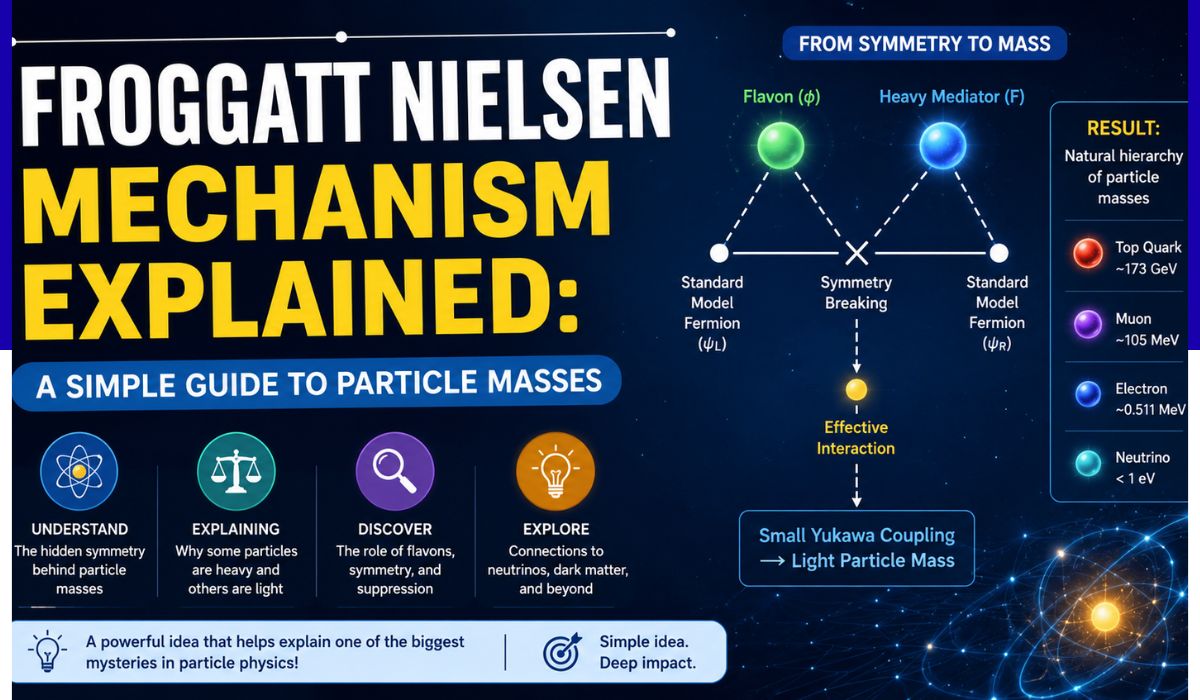
At the heart of the Froggatt Nielsen Mechanism is a simple idea: particles carry Flavor Charges under a new symmetry. This symmetry is not exact and is broken by a new scalar field called the Flavon.
When the Flavon Field acquires a Vacuum Expectation Value, it introduces a small parameter that suppresses certain interactions. This suppression creates a natural hierarchy of particle masses.
Mathematically, this suppression is often written using an Effective Operator where higher powers of the Flavon Field reduce the strength of Yukawa Couplings. This means light particles correspond to higher suppression levels, while heavy particles require fewer suppressions.
This simple structure beautifully explains why particle masses span such a wide range without requiring unnatural fine-tuning.
The Role Of Flavons In Particle Physics
Flavons are hypothetical scalar fields that play a central role in the Froggatt Nielsen Mechanism. These fields are responsible for breaking Flavor Symmetry in a controlled way.
When a Flavon Field gains a Vacuum Expectation Value, it creates a small expansion parameter that shapes the structure of particle masses. This parameter is often much smaller than one, which naturally generates hierarchical mass patterns.
Flavons are not part of the Standard Model, but they appear in many Beyond Standard Model Theories. They are also important in modern research that connects Flavor Physics with Dark Matter and Neutrino Physics.
Heavy Particles And Effective Interactions
Another important idea in the Froggatt Nielsen Mechanism is the existence of heavy mediator particles. These particles exist at very high energy scales and are not directly observable in current experiments.
Even though they are heavy, they influence low-energy physics through Effective Field Theory. In this approach, their effects appear as suppressed interactions in the Standard Model.
These suppressed interactions are responsible for generating small particle masses. This is why the Froggatt Nielsen Mechanism is often described as a bridge between high-energy physics and low-energy observations.
Why The Froggatt Nielsen Mechanism Matters
The importance of the Froggatt Nielsen Mechanism lies in its ability to explain one of the biggest mysteries in physics: the origin of mass hierarchies.
Instead of treating Yukawa Couplings as arbitrary numbers, the mechanism provides a structured explanation based on symmetry principles. This makes it more predictive and theoretically appealing.
It also plays a role in Grand Unified Theories and helps physicists understand how the Standard Model might emerge from a deeper framework.
Connection To Dark Matter Physics
In modern research, the Froggatt Nielsen Mechanism is often connected to Dark Matter models. One interesting direction is the Scotogenic Mechanism, where particle masses are generated through loop processes involving dark sector particles.
In these models, Flavor Symmetry may be linked to hidden Dark Sector Physics. This means that the same framework that explains particle masses could also help explain the nature of Dark Matter.
This connection makes the Froggatt Nielsen Mechanism even more exciting because it may unify multiple open problems in physics.
Froggatt Nielsen Mechanism And Neutrino Masses
Neutrinos are some of the most mysterious particles in the universe because they are extremely light and have unusual mixing patterns.
The Froggatt Nielsen Mechanism can naturally explain why neutrino masses are so small. It does this by assigning higher suppression factors to neutrinos compared to other particles.
It also helps explain neutrino mixing patterns, including special cases like Cobimaximal Mixing, where mixing angles take highly symmetric values. These predictions are actively studied in current neutrino experiments.
Experimental Tests And Future Discoveries
Although the Froggatt Nielsen Mechanism is theoretical, it can still be tested indirectly. Scientists look for signs such as Flavor Changing Neutral Currents, rare particle decays, and deviations in Higgs Boson interactions.
Future particle colliders and precision experiments may provide clues about whether Flavons or heavy mediator particles exist. Even small deviations from Standard Model predictions could support this framework.
This makes the Froggatt Nielsen Mechanism an active area of research in 2026 and beyond.
Challenges And Limitations Of The Theory
Despite its elegance, the Froggatt Nielsen Mechanism is not without challenges. One major issue is that it introduces new particles and symmetries that have not yet been observed experimentally.
Another challenge is that different Froggatt Nielsen models can produce similar predictions, making it difficult to identify the correct version.
Researchers are also working to integrate this mechanism into a fully unified theory that includes gravity and quantum effects.
Modern Variations Of The Froggatt Nielsen Mechanism
Modern theoretical physics has expanded the Froggatt Nielsen idea in many directions. Some models combine it with Supersymmetry, while others use Extra Dimensions or Dark Sector Physics.
One of the most interesting developments is the Scotogenic Froggatt Nielsen Framework, where particle masses arise through loop processes involving dark particles.
These modern versions aim to make the theory more predictive and potentially testable in future experiments.
Final Thoughts On The Froggatt Nielsen Mechanism
The Froggatt Nielsen Mechanism remains one of the most elegant ideas in particle physics because it transforms the mystery of particle masses into a structured and symmetrical framework. Instead of treating masses as random numbers, it suggests that hidden symmetries shape the entire pattern of matter in the universe.
As research continues into Flavor Physics, Neutrino Masses, and Dark Matter, the Froggatt Nielsen Mechanism may become even more important. It represents a step toward a deeper understanding of how the universe organizes its fundamental building blocks, and it continues to inspire new ideas in theoretical physics today.
Frequently Asked Questions About Froggatt Nielsen
What Is The Froggatt Nielsen Mechanism
The Froggatt Nielsen Mechanism is a theory that explains particle mass hierarchies using Flavor Symmetry and a scalar Flavon Field that suppresses interactions in a structured way.
Why Are Particle Masses So Different
The mechanism suggests that differences in particle masses come from different Flavor Charges, which control how strongly each particle interacts with the Higgs Field.
What Is A Flavon Field
A Flavon Field is a hypothetical scalar field that breaks Flavor Symmetry and generates small parameters responsible for mass hierarchies.
Does The Froggatt Nielsen Mechanism Explain Neutrino Masses
Yes, it can explain why neutrinos are extremely light and also help describe their mixing patterns through additional symmetry structures.
Is The Froggatt Nielsen Mechanism Proven
No, it is still a theoretical framework. However, it is widely studied because it offers a natural explanation for mass hierarchies.
Can It Be Tested Experimentally
Yes, indirectly through rare decays, flavor-changing processes, and precision measurements of Higgs interactions.
What Is The Connection To Dark Matter
Some modern models link Flavor Symmetry with Dark Sector Physics, suggesting that the same framework may explain both particle masses and Dark Matter.
Recommended For You: NBA Playoffs 2026: Biggest Upsets, Stars, And Must-Watch Moments